
Concrete Retaining Walls for Iredell County Properties
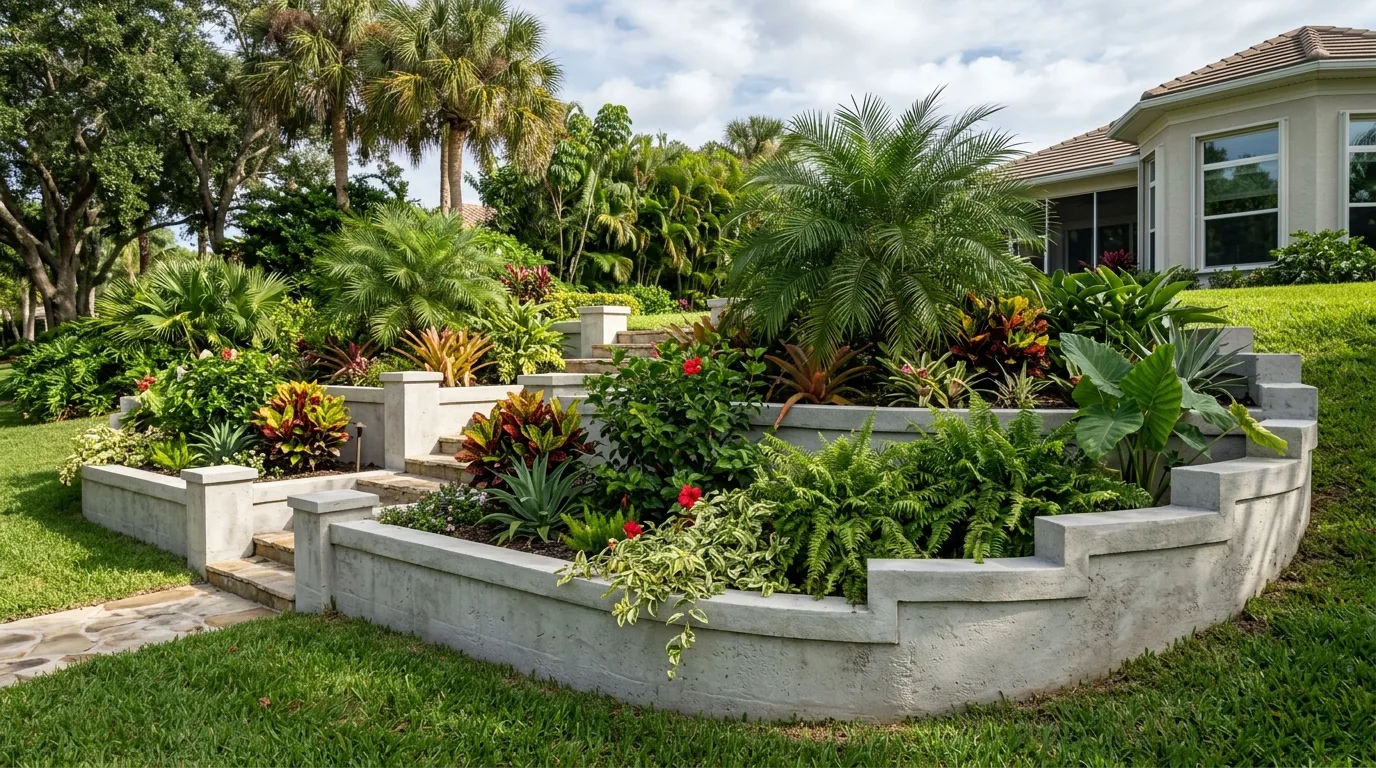
Statesville and the broader Iredell County area feature rolling Piedmont terrain where slopes are common — and where the high-clay soils that dominate the region create erosion and drainage challenges that flat properties don’t face. A properly engineered concrete retaining wall solves both problems: it holds the slope, controls water runoff from Statesville’s 44 inches of annual rainfall, and creates usable flat space on otherwise difficult terrain. This guide covers what Iredell County homeowners need to know about concrete retaining walls — design, drainage, permits, and costs.
In this post, we cover: when a retaining wall is the right solution for your Statesville property, how wall design is affected by Iredell County’s clay soils, permit requirements, and realistic cost ranges.
Retaining Wall on Your Iredell County Property? Free Estimate.
We assess slope, soil, and drainage before quoting. Call (888) 376-0955.
When You Need a Retaining Wall in Statesville
Erosion, grading, and drainage challenges on Iredell County properties often require more than re-seeding or grading alone — the clay soils that shed water so slowly tend to concentrate runoff into channels that cut through slopes progressively. A concrete retaining wall is the right solution when:
- A slope on your property is actively eroding and directing sediment-laden runoff toward your home, driveway, or adjacent property
- You want to create a usable level area (garden, patio, parking) on a sloped yard
- An existing retaining wall is showing cracks, tilting, or drainage failure
- Grade changes near the home’s foundation need to be managed to prevent water from running toward the structure
- A side yard or back yard with significant grade change needs to be terraced for landscaping
Retaining walls range from low landscape walls (18–24 inches high) that serve primarily aesthetic functions to structural walls 4–6 feet or taller that require engineered design and permits from Iredell County Building Standards.
Why Iredell County Clay Soils Make Drainage Critical
Concrete retaining walls in Statesville don’t fail from poor concrete — they fail from inadequate drainage design. Here’s the mechanism: Iredell clay soils have very slow permeability, meaning water from rain events stays in the soil adjacent to a retaining wall for extended periods, sometimes days. During this saturated period, the soil exerts hydrostatic pressure against the wall face — pressure that adds to the lateral earth pressure the wall was designed to contain.
On properties near Fort Dobbs Road and throughout the rolling western areas of Statesville, clay soils against retaining walls regularly reach saturation during winter and spring rains. A wall without drain tile behind it accumulates this hydrostatic pressure cycle after cycle. Within several years, the combined pressure exceeds the wall’s design capacity and visible cracking or tilting begins — the signature failure pattern of improperly drained retaining walls on Iredell County clay soils.
The solution is drain tile — perforated pipe installed at the base of the wall inside a gravel filter bed, with filter fabric separating the gravel from the retained clay. This drainage system intercepts water before it can build up behind the wall and directs it to a controlled outlet. The cost of drain tile is a small fraction of the wall cost; the cost of wall failure without it is the full price of replacement.
Concrete Retaining Wall Design for Statesville’s Freeze-Thaw Climate
Statesville’s December through February freeze-thaw season creates a second structural challenge for retaining walls. Saturated clay behind a wall freezes in cold snaps and expands, exerting pressure called frost heave force against the wall face. This is in addition to the normal earth pressure — the combination is what causes walls to tilt forward during winter in the Statesville area.
Two design responses mitigate frost heave: footing depth and drainage quality. Footings must extend below the frost depth for Statesville’s USDA Zone 7b climate to prevent the entire wall from being lifted and shifted by ground freezing. And the better the drainage behind the wall, the less saturated the clay becomes before each freeze — a drier clay exerts less frost heave pressure than a wet one. These two measures together dramatically reduce winter stress on retaining walls in Iredell County.
Retaining Wall Design for Statesville's Clay Soils
We include drain tile and proper footing design on every wall. Call (888) 376-0955 for a free estimate.
Practical Uses for Retaining Walls on Iredell County Properties
- Creating a level patio area: A 2–3 foot retaining wall on a sloped backyard in the Highland Park neighborhood creates a level surface for a concrete patio, effectively doubling usable outdoor space without significant regrading.
- Driveway edge stabilization: Where a driveway sits above a slope, a low retaining wall or curb prevents edge erosion and keeps the gravel base material from washing off the driveway’s edge over time.
- Terraced garden beds: Multiple low walls stepping down a slope create planting terraces that manage water runoff while creating a structured landscape feature.
- Drainage channel management: A retaining wall incorporated with a swale or French drain directs water from the upslope area around the home rather than toward it.
- Front yard grade transition: Properties in Statesville’s subdivisions near Lake Norman State Park often have grade differences between the road level and the home’s foundation grade — a retaining wall at the property edge manages this transition with controlled aesthetics.
- Erosion repair: When an existing earthen slope has eroded and threatens to continue, a retaining wall halts the problem permanently rather than requiring repeated re-seeding.
Permit Requirements for Retaining Walls in Iredell County
- Under 4 feet high: Generally no building permit required from Iredell County Building Standards, but zoning setback requirements still apply within City of Statesville limits, and Iredell County zoning setbacks apply outside city limits
- 4 feet and taller: Building permit required from Iredell County Building Standards; engineered drawings may be required
- Walls with surcharge loads (adjacent driveways, structures, or areas where heavy equipment operates): Engineered design required regardless of height
- Projects over $30,000: Licensed NC general contractor required
We assess permit requirements during the estimate process for every retaining wall project in Statesville and surrounding Iredell County communities.
Retaining Wall Cost Ranges in Statesville
Retaining wall costs vary considerably based on height, length, and drainage requirements:
- Low landscape wall (18–24 inches): $25–$40 per linear foot installed
- Mid-height structural wall (3–4 feet): $40–$70 per linear foot installed
- Tall structural wall (5–6 feet) with engineered design: $75–$150+ per linear foot installed
These ranges include drain tile and basic drainage design as standard — not as an optional add-on. A wall quote that doesn’t include drainage is not a complete quote for an Iredell County clay-soil site.
Frequently Asked Questions
Do I need a permit for a retaining wall in Statesville NC?
Retaining walls under 4 feet typically don’t require a building permit, but zoning setback requirements apply. Walls 4 feet and taller require a building permit from Iredell County Building Standards, and engineered drawings may be required. For projects exceeding $30,000 total cost, a licensed NC general contractor is required. We advise on permit requirements during the estimate process for every wall project.
How long will a concrete retaining wall last in NC?
A properly engineered and installed concrete retaining wall in North Carolina, with adequate drainage and frost-depth footings, can last 40–60 years or more. The drainage component determines more of the wall’s actual lifespan than the concrete mix or wall thickness — walls that fail in Iredell County almost always fail from hydrostatic pressure buildup behind them, not from concrete quality issues.
What is the best type of retaining wall for Statesville’s clay soils?
Concrete offers the best combination of strength and impermeability for clay soil environments like Iredell County. Block walls (segmental retaining wall blocks) are an alternative with good performance if properly backfilled with gravel and drained — but they require more careful attention to drainage than poured concrete walls because water can infiltrate through the block joints. For walls over 3 feet where structural performance matters, poured concrete with proper engineering is preferred.
Concrete Retaining Walls Built for Iredell County
Call Statesville Concrete Pros at (888) 376-0955 for a free estimate. Serving Statesville, Hickory, Lincolnton, Newton, and all of Iredell County.
Related: