
Iredell County Clay Soils: What It Means for Your Concrete Project
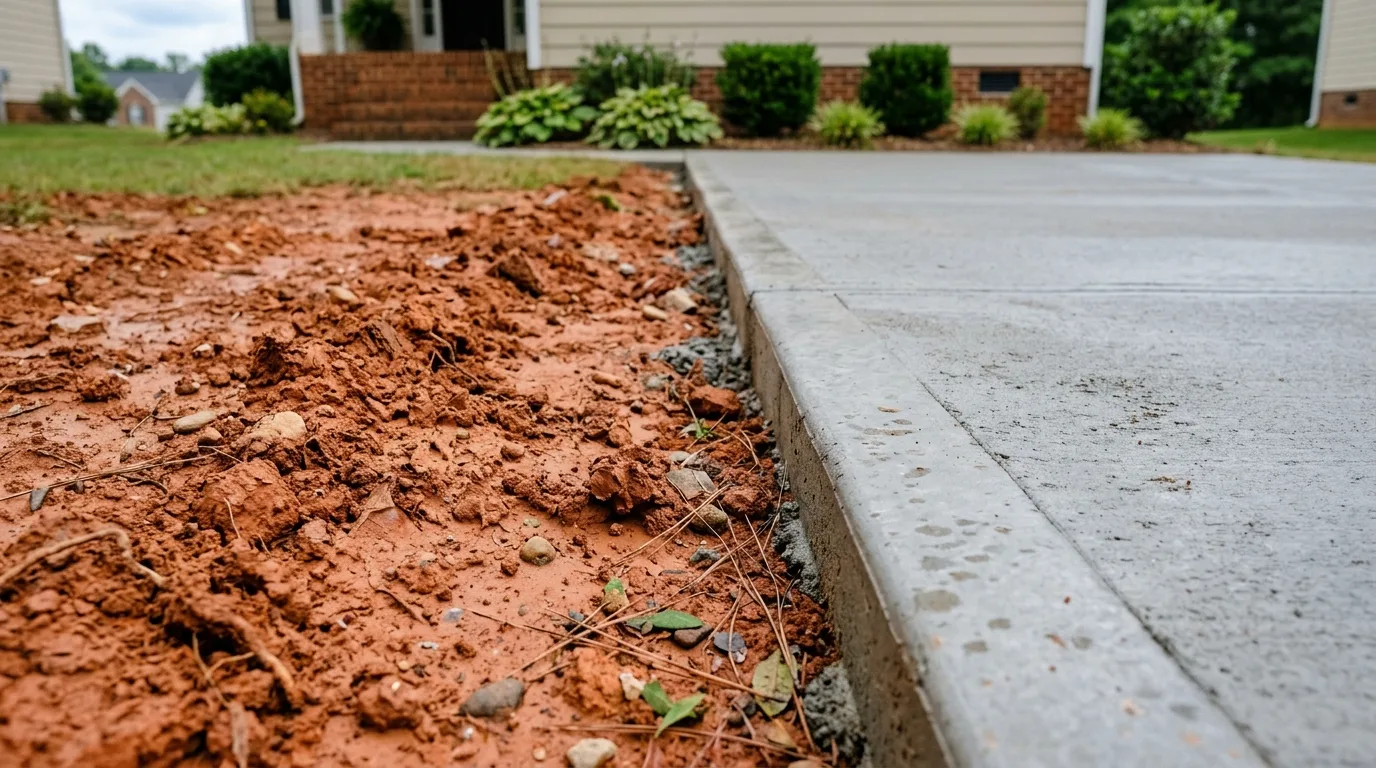
Most concrete problems in Statesville start underground, not at the surface. The Iredell soil series — named after Iredell County and dominant throughout the area — has characteristics that make it one of the more challenging substrates for concrete flatwork in the Piedmont NC region. Understanding what that soil is doing beneath your driveway, patio, or slab explains why some Statesville concrete fails prematurely and how properly prepared concrete avoids those failures.
In this post, we cover: what makes Iredell County’s clay soils different, how they affect different types of concrete projects, and what proper base preparation looks like on these soils.
Get a Soil-Informed Concrete Estimate in Statesville
We assess your site conditions before quoting — every project. Call (888) 376-0955.
What Is the Iredell Soil Series?
The Iredell soil series is a fine, mixed, active, thermic soil classified as an Oxyaquic Vertic Hapludalf — a technical designation that carries some important practical meanings for concrete contractors working in the Statesville area.
Clay content: The Bt horizon (the main clay-enriched layer) has 40–85% clay content. This is very high. For context, soils above 40% clay are classified as heavy clays; Iredell soils regularly hit that upper range in the subsoil.
Shrink-swell potential: The USDA rates the Iredell series as having VERY HIGH shrink-swell potential in the Bt horizon. This means the soil expands significantly when wet and contracts significantly when dry — not a small difference, but a meaningful volumetric change that occurs with every major rain-dry cycle.
Permeability: Water moves through Iredell soils at 0.0015–0.06 inches per hour in the clay-dominated layers. This is extremely slow — after a rain event, water sits in and against the soil for extended periods before draining. Combined with Statesville’s 44 inches of annual rainfall distributed throughout the year, this means the soil beneath concrete is often wet or saturated for significant periods.
Seasonal water table: The perched water table in Iredell soils typically sits at 1.0–2.0 feet below the surface from December through April. This is the period when the weight of the soil above the clay layer traps moisture in a temporary perched zone — the water table is actually resting on top of the clay rather than draining through it.
How These Soil Characteristics Affect Statesville Concrete
Driveways and patios: The shrink-swell cycle is the primary issue. When Iredell clay gets wet, it expands and pushes upward against the concrete slab above it. When it dries, it contracts and pulls away, leaving voids beneath the slab. The slab now spans those voids with no support — which is when cracking begins, typically along the edges and at control joints. Homeowners throughout the Academy Hill Historic District and Downtown Statesville areas see this pattern in older driveways: diagonal cracks radiating from corners, settled sections near the street, and joints that have widened over years of seasonal cycling.
Foundations and slabs: The combination of clay’s slow drainage and the perched water table means foundations in Statesville are in contact with saturated or near-saturated soil for months of the year. Without adequate drainage management — waterproofing, drain tile, grading — this moisture contact accelerates both chemical attack on the concrete and the physical pressure from seasonal soil movement.
Retaining walls: Saturated Iredell clay behind a retaining wall generates hydrostatic pressure that exceeds the pressure dry or partially saturated soil would create. Without drain tile and filter fabric installed at the wall base during construction, this pressure accumulates over years until it exceeds the wall’s design capacity.
What Proper Base Preparation Looks Like on Iredell County Soils
On properties where the Iredell series dominates — which includes most of Statesville and the surrounding county — proper base preparation for a concrete slab or driveway means more than the minimal industry standard. Here’s what distinguishes a properly prepared site on Iredell clay from a minimal one:
Excavation depth: Standard concrete base prep may call for 4–6 inches of gravel. On Iredell clay, we frequently go deeper — 8–10 inches — to reach a zone where the most problematic clay is removed and replaced with stable material. The additional excavation and gravel material adds cost, but it’s the investment that determines long-term performance.
Base material: Crushed angular gravel (NCDOT #57 or similar) is the appropriate base material. Angular gravel compacts tightly and drains freely. Rounded river gravel does not compact as firmly. Native soil or fill soil is not an appropriate base material for concrete, regardless of how well it compacts initially.
Drainage design: Grading the subgrade to drain away from the slab, and potentially installing perimeter drain tile to direct groundwater away before it can saturate the base, is standard practice on problematic Iredell clay sites. This is particularly important near foundations and for driveways where the base slopes toward the garage.
Compaction: The gravel base must be mechanically compacted in lifts — typically 3–4 inch layers, each compacted before the next is added. A single thick pour of gravel without compaction settles over time, which leads to slab settlement and cracking.
Concrete Designed for Iredell County Soil Conditions
We assess your soil before every project. Proper base prep isn't optional here — it's what makes the difference. Call (888) 376-0955.
Practical Uses: How Soil Knowledge Affects Your Concrete Project
- Driveway installation: When replacing a Statesville driveway, asking a contractor specifically about their excavation depth and base material on your site tells you quickly whether they understand local soil conditions. A vague or dismissive answer is a red flag.
- Patio installation: Clay beneath a patio creates the same shrink-swell problems as beneath a driveway. Patios near Downtown Statesville and Highland Park that are installed on native clay without adequate base preparation often develop corner lift and settlement cracking within 5 years.
- Foundation work: Structural foundation design in Iredell County should account for the high-shrink-swell classification in the soil report. For new construction, a geotechnical investigation identifies the specific soil profile and informs footing design. We coordinate with project engineers on structural foundation work.
- Retaining walls: If you’re planning a retaining wall on a Statesville property, ask the contractor specifically about drain tile and filter fabric installation. A contractor who doesn’t include these in their wall quote is not accounting for Iredell County’s clay soil moisture retention characteristics.
- Garage floor slabs: Garage floors poured on native clay without base replacement are vulnerable to the seasonal heaving that causes slab cracking across the middle of the floor — the most common garage floor failure pattern in older Statesville homes.
How Moisture and Drainage Interact With These Soils
The slow permeability of Iredell clay means that water from a significant rain event may take days to drain through the soil profile. During Statesville’s winter and spring months, when the perched water table is already near the surface, additional rainfall has nowhere to go quickly. The practical result: concrete projects in this area need drainage designed for worst-case moisture conditions, not average conditions.
When drainage corrections are included in a concrete estimate — French drains, regraded subgrade, perimeter drain tile — they’re not add-ons inflating the quote. They’re the components that make the concrete perform as expected in Iredell County’s actual conditions. A quote that omits drainage on a site that needs it is a cheaper quote today and an expensive one in 5 years.
Frequently Asked Questions
Does the Iredell soil affect every concrete project in Statesville?
The Iredell series is dominant across Statesville and much of Iredell County, but other soil types are also present — Cecil, Pacolet, and Fairview series in the upland areas are generally better-draining sandy clay loams that present fewer challenges for concrete. The most problematic areas tend to be lower-lying sites where Iredell clay accumulates and where the perched water table sits highest. A site assessment before any concrete project tells us what we’re working with.
How do I know if my Statesville property has Iredell clay soils?
A quick visual indicator: does the excavated native soil have a yellowish-brown to reddish clay appearance and feel very sticky when wet? That’s consistent with the Iredell series. More definitively, a soil probe or excavation before concrete work confirms the soil profile. We assess every site before quoting — it’s the only way to price the base preparation component accurately.
What happens if concrete is poured directly on Iredell clay without base prep?
The concrete will typically perform adequately for the first few years while the clay remains relatively stable. As seasons pass and the shrink-swell cycling accumulates, voids develop beneath the slab, edges crack and settle, and mid-slab diagonal cracking follows. Most concrete failures in Statesville that appear within 5–10 years trace back to inadequate base preparation on the clay subsoil. The failure looks like a concrete problem, but the root cause is underground.
Properly Prepared Concrete for Iredell County Properties
Call Statesville Concrete Pros at (888) 376-0955. We assess your soil before quoting, every time. Serving Statesville, Mooresville, Hickory, and all of Iredell County.
Related: